Curmel Moton Cleared to Return: Suspension Lifted and Comeback Set on Major February Card

fter more than a year away from competition, Curmel Moton is officially back. One of boxing’s most talked-about young prospects has been cleared to return following a suspension that kept him sidelined during a critical stage of his development. Now, with that chapter closed, Moton is set to step back into the ring on a meaningful stage—and the boxing world is watching closely.

What Happened: The Suspension

Moton’s absence wasn’t due to injury or inactivity by choice. He was suspended following an administrative issue related to regulatory compliance, which ultimately resulted in him being unable to compete for over a year. While details surrounding suspensions are often less glamorous than knockouts and highlight reels, they can be career-altering—especially for a young fighter building momentum.

For Moton, the time away became a test of discipline and patience. Staying sharp without fights, maintaining focus, and preparing for an eventual return are challenges only serious fighters survive. The fact that he’s back now speaks volumes about his commitment to the sport.

The Return: February 28 at Turning Stone

Moton’s comeback is scheduled for February 28 at Turning Stone Resort Casino, on a card promoted by MP Promotions. The same event also features Manny Pacquiao Jr., adding extra attention and energy to the night.

The card will be headlined by Elijah Pierce vs Lorenzo Parra, making this more than just a return bout—it’s a serious boxing event with eyes from fans, media, and industry insiders alike.

Why This Fight Matters

For Moton, this isn’t just about shaking off ring rust. It’s about re-establishing himself as a rising force and reminding people why his name carried buzz in the first place. Long layoffs can stall careers, but they can also forge tougher fighters—ones who come back sharper, more focused, and more dangerous.

This fight is the reset button. A chance to silence doubts, reassert momentum, and step back into the trajectory he was on before the suspension.

The KLEOS Perspective

At KLEOS, we believe legacy isn’t defined by uninterrupted success—it’s built by how you respond when things get taken away. Moton’s return embodies that mindset. Time away. Adversity. Accountability. Then action.

February 28 isn’t just a date on the calendar. It’s a statement. Curmel Moton is back, cleared, and ready to move forward—and boxing is better when fighters like this get their second chapter.

Legacy is earned. And sometimes, it’s earned the hard way. 🥊
Anthony Joshua Officially Retires From Boxing: A Legacy That Transcends the Ring

The sport of boxing turns a significant page today as Anthony Joshua has officially announced his retirement from professional boxing. For fans, fighters, and the next generation watching from the outside of the ropes, Joshua’s exit marks the end of an era defined by discipline, power, global influence, and resilience.

From Olympic Gold to Global Superstar

Anthony Joshua’s rise wasn’t accidental—it was built. After capturing Olympic gold at the 2012 London Games, Joshua transitioned into the professional ranks with the weight of a nation’s expectations on his shoulders. He didn’t just meet them—he exceeded them.

His early knockout streak announced the arrival of a new heavyweight force. Soon after, world titles followed. Joshua unified the heavyweight division, holding multiple belts and headlining sold-out stadiums across the UK and beyond. Wembley Stadium became synonymous with his name.

Championships, Comebacks, and Character

Joshua’s career wasn’t without adversity—and that’s what makes it legendary.

He became a two-time heavyweight world champion, reclaiming his titles after defeat and proving that greatness isn’t about never falling—it’s about standing back up. His willingness to face elite competition, accept criticism, and evolve as a fighter earned him respect far beyond win-loss records.

In an era driven by hype, Joshua carried himself like a professional at all times. Win or lose, he represented the sport with class.

More Than a Boxer

Anthony Joshua’s influence extends far outside the ring. He helped bring boxing back into mainstream global culture, inspiring young athletes—especially in underserved communities—to believe in discipline, structure, and self-belief.

He became a symbol of modern heavyweight boxing: powerful, marketable, thoughtful, and accountable. Few fighters carry themselves as champions in both victory and defeat. Joshua consistently did.

A Legacy Cemented

Retirement doesn’t erase a legacy—it solidifies it.

Anthony Joshua will be remembered as:

For boxing, his absence will be felt. For history, his place is secure.

Respect From KLEOS

At KLEOS, we honor fighters who embody legacy, discipline, and earned greatness. Anthony Joshua’s career reflects everything we stand for—legacy isn’t given, it’s earned.

Thank you, AJ, for the memories, the wars, and the standard you set for the sport.

Your chapter may be closed—but your impact will never fade. 🥊

WBA Removes Jake Paul From Its Rankings: What It Means for Boxing’s Future

The World Boxing Association (WBA) has officially removed Jake Paul from its list of ranked boxers — a move that reignites one of the most polarizing debates in modern boxing: What should ranking actually represent?

At KLEOS, we live at the intersection of legacy, discipline, and earned respect. So this decision matters — not just because it involves a headline name, but because it speaks to the soul of the sport.

Why the WBA Removed Jake Paul From the Rankings

The World Boxing Association has long stated that rankings are meant to reflect competitive merit, level of opposition, and activity against top contenders within a division.

While Jake Paul has:

His résumé still lacks the core element rankings are supposed to honor: wins against consistently ranked, active professional boxers in his division.

The WBA’s decision signals a clear line in the sand — popularity alone doesn’t equal contender status.

Entertainment vs. Earned Legacy

There’s no denying Jake Paul’s impact. He’s disrupted boxing promotion, leveraged digital influence better than anyone before him, and forced the sport to confront its relationship with entertainment.

But boxing has always drawn a distinction between selling tickets and earning rank.

Rankings exist to identify who has:

That path is brutal, unforgiving, and — most importantly — earned.

What This Means for Boxing Purists

For fighters grinding in gyms worldwide, the WBA’s move is validation.

It reinforces that:

This matters for the next generation — fighters who train without cameras, without viral moments, and without shortcuts.

Can Jake Paul Earn His Way Back?

Absolutely.

This isn’t a ban. It’s a reset.

If Jake Paul:

Then the rankings will reflect that growth.

Boxing has always respected one thing above all else: what happens between the ropes.

Why This Decision Aligns With the KLEOS Philosophy

At KLEOS, our message is simple:

Legacy is earned. Boxing is in our DNA.

We respect anyone willing to step into the ring — but we honor those who:

The WBA’s decision isn’t about hating innovation or denying change. It’s about protecting the foundation of a sport built on courage, sacrifice, and truth.

Final Thoughts

Jake Paul isn’t going anywhere — and neither is the conversation he started. But rankings aren’t meant to reward attention. They’re meant to reflect achievement.

If boxing is going to evolve, it still needs an anchor.
And sometimes, that anchor is saying: earn it.

That’s boxing.
That’s legacy.
That’s KLEOS. 🥊

Two Members of Anthony Joshua’s Team Killed in Tragic Car Accident in Nigeria

A tragic car accident in Nigeria has claimed the lives of two close friends and team members of Anthony Joshua, sending shockwaves through the global boxing community.

The incident occurred on the Lagos–Ibadan Expressway, where Joshua was traveling as a passenger in a vehicle that was involved in a serious crash. Reports confirm that Anthony Joshua was not driving at the time of the accident. He sustained minor injuries and was treated at a local hospital before being released in stable condition.

Sadly, the crash resulted in the deaths of:

Both men had worked closely with Joshua for years and were widely regarded for their professionalism, loyalty, and contribution to his career.

Authorities are continuing to investigate the circumstances surrounding the accident. Early reports indicate the vehicle collided with a stationary truck on the highway, a route known for heavy traffic and safety concerns. No wrongdoing has been attributed to Joshua, who was not operating the vehicle.

Tributes have poured in from across the boxing world, with fighters, trainers, and fans expressing sorrow and solidarity with Joshua and the families affected by the loss.

KLEOS Statement of Condolence

At KLEOS, we extend our deepest condolences to the families, friends, and loved ones of Sina Ghami and Latif “Latz” Ayodele. Their passing is a devastating loss, and our hearts are with everyone mourning them.

We also send our thoughts and support to Anthony Joshua during this incredibly difficult time. May he find strength as he grieves the loss of two people who meant so much to him, both personally and professionally.

Naoya Inoue Dominates Picasso to Retain Undisputed Super-Bantamweight Crown

December 27, 2025 — Riyadh, Saudi Arabia — Boxing’s pound-for-pound king, Naoya “The Monster” Inoue, delivered another masterclass early this morning, defeating Alan Picasso by clear unanimous decision to retain his undisputed super-bantamweight championship.

From the opening bell, Inoue imposed his will with elite footwork, razor-sharp timing, and relentless pressure. He mixed fast combinations upstairs with punishing body shots, keeping Picasso on the defensive and in survival mode for much of the fight. While Picasso showed toughness and heart, he struggled to find sustained success against Inoue’s speed and precision.

Inoue’s control never wavered. He dictated range, won exchanges with clean counters, and consistently beat Picasso to the punch. Though the bout went the full 12 rounds—denying fans another trademark knockout—the scorecards told the story of a dominant performance in favor of the Japanese champion.

With the victory, Inoue remains undefeated and firmly in command of the division, continuing his reign as holder of all major super-bantamweight titles. The win also reinforces his reputation as one of the most complete fighters of his generation, capable of dismantling opponents with power, intelligence, and composure.

Attention now turns to what’s next. A potential mega-fight looms on the horizon, with talk of a high-stakes showdown against another elite contender that could define the next chapter of Inoue’s legacy. For now, though, the message is clear: at super-bantamweight, Naoya Inoue remains untouchable.

Did Anthony Joshua End Jake Paul’s Boxing Career? The Fight That Changed Everything

The boxing world is buzzing after reports and widespread viewer claims surrounding a heavyweight clash between Jake Paul and former unified champion Anthony Joshua, streamed on Netflix.

According to those accounts, the fight ended violently — with Joshua overwhelming Paul and leaving him with catastrophic facial injuries. If accurate, the aftermath raises a serious question that can’t be ignored:

Did Jake Paul finally go too far — and could this be the end of his boxing career?

A Dangerous Leap Into the Heavyweight Deep End

For years, Jake Paul has walked a fine line between spectacle and legitimacy. He progressed from fellow influencers to former MMA champions and professional boxers — but a true elite heavyweight like Anthony Joshua represents a completely different universe.

Joshua isn’t just bigger.
He’s faster, more experienced, and carries knockout power refined at the championship level.

Reports from the fight claim that gap showed brutally.

The Injuries That Changed the Conversation

Viewers and post-fight discussion allege that Paul suffered severe trauma, including:

If these injuries are accurately reported, they are not cosmetic setbacks — they are career-altering injuries, particularly for a fighter whose brand depends on durability, confidence, and forward pressure.

Jaw fractures aren’t just painful. They affect:

Fighters can come back from them — but they are never the same fighter afterward.

The Psychological Cost May Be Even Higher

Physical healing is only part of the equation.

Taking a decisive loss — especially one involving serious injury — changes how a fighter is perceived and how they perceive themselves. For Jake Paul, whose success has been built as much on momentum and bravado as skill, this kind of defeat hits differently.

Future opponents no longer see a novelty act.
They see vulnerability.

And promoters may hesitate to place him against opponents who can genuinely hurt him — not for competitive reasons, but for liability ones.

Could Jake Paul Continue Boxing?

Possibly — but not in the same way.

If Paul returns, the path almost certainly looks different:

What seems far less likely is another jump into the upper echelon of heavyweight boxing.

At that level, the margin for error is nonexistent.

The Bigger Picture: Influencer Boxing Meets Reality

This moment — real or reported — underscores a truth boxing has always enforced eventually:

Weight classes exist for a reason.
Experience matters.
Power changes everything.

Jake Paul helped bring massive attention and new audiences to boxing. That contribution is real and undeniable. But if the claims surrounding this fight hold, it may also mark the moment where entertainment collided head-on with consequence.

Final Take

If the reported injuries and outcome are accurate, this fight wasn’t just a loss — it was a reckoning.

Whether Jake Paul boxes again or not, the version of his career that involved testing himself against elite heavyweight champions may already be over.

And if this truly was the price of crossing that line, it may stand as the clearest warning yet that boxing — real boxing — eventually collects its due.

The Mayweather Family Legacy: Four Men Who Shaped Boxing History

When people hear the name Mayweather, they often think of undefeated records, championship belts, and global superstardom. But the truth is, the Mayweather legacy wasn’t built overnight—and it wasn’t built by one man alone.

It was forged through generations of fighters, trainers, and teachers who lived and breathed boxing. From the gritty gyms of Grand Rapids to the bright lights of Las Vegas, the Mayweather family has left an indelible mark on the sport.

This is the story of Floyd Mayweather Sr., Roger Mayweather, Jeff Mayweather, and Floyd Mayweather Jr.—four men, four paths, one legacy.

Floyd Mayweather Sr.: The Foundation

Floyd Mayweather Sr. is where the roots of the Mayweather boxing tree truly begin.

A former professional boxer himself, Mayweather Sr. fought some of the toughest competition of his era, including a bout against Sugar Ray Leonard. But his most lasting impact came not from his own record, but from his boxing mind.

Known for his emphasis on:

Mayweather Sr. became a respected trainer who understood boxing as both an art and a science. His teachings laid the groundwork for the defensive brilliance that would later define the Mayweather name.

He didn’t just train fighters—he taught them how to think in the ring.

Roger “The Black Mamba” Mayweather: The Warrior Teacher

Roger Mayweather, affectionately known as “The Black Mamba,” was the family’s most feared warrior.

A two-division world champion, Roger was known for his toughness, sharp punching, and no-nonsense approach. He fought elite competition and earned his place as a legitimate world champion during a brutal era of boxing.

But Roger’s influence extended far beyond his own career.

As a trainer, he became one of the most important figures in boxing history—most notably as the longtime trainer of Floyd Mayweather Jr. Roger was instrumental in shaping the defensive mastery and ring control that would later dominate the sport.

Roger Mayweather wasn’t just a champion.
He was a teacher who helped create one.

Jeff Mayweather: The Technician

Often described as the most technical boxing mind in the family, Jeff Mayweather carved his own path as both a fighter and a trainer.

Jeff Mayweather was not only a respected trainer but also an accomplished professional fighter who captured a world-level championship belt during his career, adding firsthand experience to the technical insight he later brought to training and fighter development. Jeff competed professionally and later transitioned into training, where his deep understanding of fundamentals, strategy, and fighter development set him apart. Known for breaking down boxing at its core, Jeff has trained and worked with world champions and contenders across multiple weight classes.

His approach emphasizes:

Jeff Mayweather represents the cerebral side of the family legacy—the teacher who focuses on mastery, not shortcuts.

Floyd Mayweather Jr.: The Global Icon

Floyd Mayweather Jr. is the most recognizable name in boxing history—and arguably the most successful.

An undefeated world champion across five weight classes, Floyd Jr. redefined what it meant to be a boxer in the modern era. His defensive brilliance, adaptability, and unmatched ring IQ made him nearly untouchable inside the ropes.

Outside the ring, he transformed boxing into a global business, becoming one of the highest-paid athletes of all time and changing how fighters think about money, promotion, and ownership.

But Floyd Jr.’s greatness didn’t come from nowhere.

It was the product of:

He is the culmination of generations of boxing knowledge.

One Family. One Legacy.

What makes the Mayweather family unique isn’t just championships or fame—it’s continuity.

Boxing knowledge passed down.
Lessons refined over decades.
A shared respect for the craft.

Each Mayweather brought something different to the table:

Together, they created a legacy that will be studied, debated, and respected for generations.

Carrying the Legacy Forward

The Mayweather name represents more than wins and losses—it represents discipline, intelligence, and respect for the art of boxing.

That legacy continues to inspire fighters, trainers, and fans around the world.

And for those who understand what the name truly stands for, it isn’t just history—it’s heritage.

The influence of the Mayweather family extends beyond the ring and into culture itself. To honor that legacy, KLEOS (Co-founded by Jeff Mayweather) created the Mayweather Legacy Tee—a collector’s piece designed for those who understand the history, discipline, and impact behind the name. The shirt isn’t about hype; it’s about respect for the craft and the generations that built it.

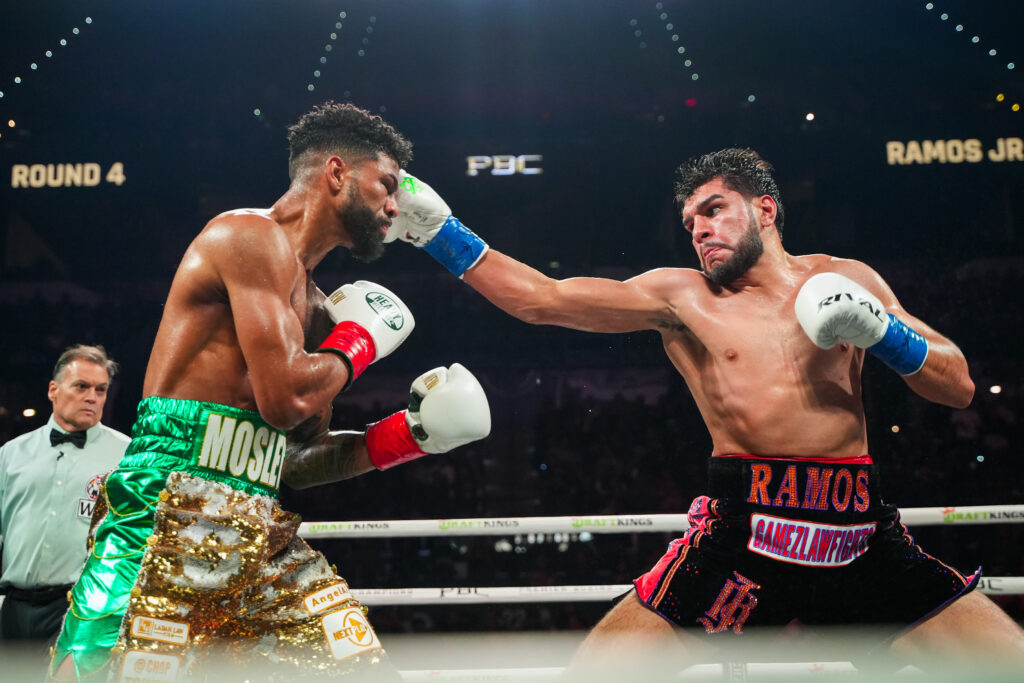
Jesus Ramos Jr. Outlasts Shane Mosley Jr. in High-Pressure San Antonio War

Two fighters entered San Antonio with something to prove — and neither left unchanged.

Jesus Ramos Jr., looking to rebound and reassert himself as a rising star, met Shane Mosley Jr., the legacy-driven technician hungry for a breakthrough statement win of his own. It became a tactical, grinding 10-round battle where both men had moments, but ultimately Ramos imposed just enough intensity and pressure to secure a unanimous decision.

Mosley’s Smart Start, Ramos’ Gradual Takeover

Mosley opened the fight well, reading Ramos’ rhythm and testing his timing early. His movement and counters disrupted Ramos’ comfort zone, forcing him to rethink his entry points.

Mosley’s jab was clean, his feints set traps, and he wasn’t intimidated by Ramos’ size or power. At times, it looked like Mosley might be able to slow the fight down enough to steal momentum.

However, Ramos — noticeably rusty early — began warming into his offense.

This wasn’t accidental. Afterward, Ramos revealed why:

"I'm not gonna lie, it was tough. I actually had a right-hand injury the last three weeks of camp. We didn't spar for the last four weeks. So it was tough to get my timing. I would catch a rhythm and lose it."

That inconsistency showed through the first half of the fight, where Mosley was able to counter and disrupt the flow.

Mosley Surprised Him Too

What Ramos didn’t expect was the quality of the shots Mosley landed—nothing devastating, but sharp enough to make him reset.

"He never hurt me but he did surprise me. He hit me with shots I wasn't expecting. But I never felt like my legs weren't there."

Mosley earned respect inside the ring — and among fans — for his poise and execution.

The San Antonio Crowd Became Ramos’ Fuel

As the fight progressed, Mosley continued to find moments, especially when Ramos paused offensively. But the crowd — roaring for Ramos — shifted momentum down the stretch.

"The crowd was giving me fuel. I was listening to my family and hearing my father's voice and I was able to push more and bring the best out of me."

Rounds 8 through 10 were where Ramos dug in, turned up his output, and finally widened the scoring gap.

A Mental Fight As Much As a Physical One

Mosley imposed tactics; Ramos imposed trauma and will.

Late in the fight, Ramos admitted he battled himself more than Mosley:

"I kept getting flashbacks and I didn't want the same thing to happen again. I kept pushing and pushing. I was in a dark place in that 10th round."

Mosley tried to surge, but Ramos finished harder, banking the championship rounds to close the show.

Official Scorecard Table

Despite Mosley’s competitive stretches, judges saw Ramos ahead throughout.

Texas Commission Official Scores

JudgeWinnerFinal Score
Judge 1Jesus Ramos Jr.116 – 112
Judge 2Jesus Ramos Jr.117 – 111
Judge 3Jesus Ramos Jr.117 – 111

Result: Unanimous Decision — Jesus Ramos Jr.

What’s Next For Ramos?

Ramos immediately set his target:

"I want Carlos Adames. He's the full champion. I don't want the interim belt, I want the champion."

He proved he can grind through adversity — but Adames would demand another level.

Where Does Mosley Go From Here?

Shane Mosley Jr. earned respect Saturday night. Many expected Ramos to simply walk through him — but Mosley’s composure, timing, and stubbornness made Ramos uncomfortable all night.

He didn’t win, but he elevated his stock and proved he’s a legitimate player at 160 — dangerous for anyone who overlooks him.

Expect him back soon, maybe in another high-profile test or a title eliminator.

Conclusion

It wasn’t spectacular — it was grueling.

Ramos pushed through injury, doubt, and difficult moments while Mosley pushed him to adjust and earn it.

San Antonio saw two versions of greatness:

And together, they made one of the weekend’s most compelling battles.

Erislandy Lara vs. Johan Gonzalez: Experience vs. Youth Under the San Antonio Lights

Saturday night in San Antonio delivered a compelling matchup between veteran Cuban master Erislandy Lara and the hungry Venezuelan contender Johan Gonzalez. It wasn’t a war of reckless exchanges — it was a chess match disguised as a fight, one full of tactical layers, mental battles, and moments where seasoned poise clashed with ambitious aggression.

Fans inside the arena watched Lara’s experience unfold against Gonzalez’s intensity. The result? A clinical performance that reminded the boxing world why Lara remains one of the sport’s most intelligent technicians — even at 42 years old.

Lara Speaks: “We Executed the Game Plan”

After the fight, Lara didn’t hold back when speaking on Gonzalez’s approach.

Erislandy Lara:
"Gonzalez came to fight and he came to win. We knew him a little bit, so we were ready for that and we made the adjustments we needed to make. He was a tough opponent who had a great opportunity in front of him, but we executed the game plan."

The Cuban southpaw, known for his ring IQ, also acknowledged the psychological games happening inside the ropes.

Lara:
"The talking in the ring is one of his tactics. He likes to do that in the gym to get you out of your game plan. But my experience kicked in, I stayed focused and got the win."

And with critics questioning his longevity, Lara delivered a message to the boxing world:

Lara:
"I showed the world that I'm 42-years-old and I'm still at the top of my game. I can compete with the best. I don't care at all about Janibek and I don't wanna talk about him any more."

It was as confident as it was defiant — a statement that Lara is still chasing big fights but on his terms.

Gonzalez Responds: “I Was Ready — No Excuses”

Meanwhile, Johan Gonzalez didn’t shy away from evaluating where things went wrong.

Johan Gonzalez:
"I spend all my time at the gym, so I had no problem being ready for this fight. There are no excuses, but I did feel that Lara didn't come to fight me the way he said he would."

He also reflected on the early rounds where momentum shifted:

Gonzalez:
"I felt a little uncomfortable in the first few rounds. The first knockdown was a punch and a slip. The second was a clean shot from Lara."

For Gonzalez, this may be a loss, but it was also an opportunity — a learning experience against one of the most difficult styles in the sport.

A Tactical Night in Texas

While the bout didn’t erupt into a firefight, it was a showcase of discipline, timing, and layered adjustments. Lara’s jab dictated pace, while Gonzalez tried to pressure and unsettle the Cuban with ring chatter and aggression.

The crowd in San Antonio witnessed a master class from an aging elite fighter who refuses to fade quietly. And though Gonzalez falls short, he proved that he belonged in the ring with top-level talent — something that could fuel his next campaign.

Final Thoughts

Saturday night wasn’t just another win for Erislandy Lara — it was a message:

He may be 42, but he’s far from done.

For Johan Gonzalez, the loss doesn’t diminish his potential. He showed heart, durability, and a willingness to learn in real time — qualities that often shape future champions.

San Antonio got a night of sharp boxing, proud declarations, and two fighters walking away believing they proved something — both to the crowd and to themselves.

O’Shaquie Foster vs Stephen Fulton: Chess, Fire, and High Stakes in the Ring

The boxing world waited eagerly to see whether O’Shaquie Foster — one of the sport’s most technically gifted champions — could solve the puzzle presented by Stephen “Cool Boy Steph” Fulton, a fighter celebrated for ring IQ, rhythm control, and adaptability. What unfolded was a battle that showcased elite skill, mental warfare, and momentum shifts that kept fans glued to every round.

This wasn’t just a fight — it was a broadcast of boxing intelligence.

Foster: Calm Fire with a Statement to Make

Foster came in with something to prove.

After earlier setbacks and promotional battles, his rise has been fueled by resilience, discipline, and what insiders call “underrated brilliance.” Against Fulton, Foster’s composure, counter timing, and athletic defense shone immediately.

He refused to be rushed or dictated to.
Instead, he made Fulton work for every opening.

Foster’s jab was educated — stiff enough to disrupt, smart enough to measure.

His footwork kept him off the boundaries Fulton typically builds momentum on.
And when Fulton tried to establish the rhythm he’s known for, Foster disrupted him with pivots, angle shifts, and sneaky right hands.

That was the invisible narrative of this matchup:

Ring personality vs ring disruptor.

Fulton’s Heart and Adjustments Were On Full Display

To his credit, Stephen Fulton wasn’t simply being outclassed — he was forced into a higher gear.

Fulton did what champions do:

✔ tightened his guard
✔ dug to the body
✔ used shoulder feints to bait Foster’s counters
✔ pressed the action when needed

Every time it appeared he might lose footing, he found a tactical answer.
But Foster had responses of his own, digging deeper into his bag.

The back-and-forth cerebral strain made this fight compelling.
It was less of a brawl, more of a technical duel — one fans with educated boxing eyes will replay repeatedly.

The Turning Point

As the rounds progressed, Foster’s IQ became the differentiator.

His defensive reads sharpened,
his punch selection widened,
and his timing matured.

Fulton landed meaningful shots, but Foster’s ability to dampen momentum — to take the air out of a surge — became the deciding factor.

Certain rounds became statement sequences from Foster:

• a pivot escape
• a stiff counter
• a perfectly timed jab–right hand split
• an exchange won on balance and accuracy

These are the things judges and trainers admire but casual fans often miss.

Closing Stretch: Foster Becomes the Narrator

In the late rounds, Foster took control of the story:

He threw the cleaner shots.
He dictated the geography of the ring.
He froze Fulton’s transitional rhythm.

At that point, he wasn’t trying to survive — he was trying to separate himself.

And he did.

What This Fight Means for Both Men

For O’Shaquie Foster:

This was validation.

His name now carries more weight in the pound-for-pound conversation, and he showcased the poise and craft to trouble any elite fighter from featherweight through super featherweight.

The question now is:

How big can Foster become — and how soon?

O’Shaquie Foster Reacts — Wants Shakur Stevenson Next

O’Shaquie Foster delivered his own standout performance and shared meaningful insight in the post-fight room:

“The game plan was to stay smart, stay sharp and get him out of there in the later rounds. But he’s a damn good fighter and a veteran and he knew how to survive.”

“I want Shakur Stevenson. I’ve been saying it for the longest. But it looks like he’s gonna fight at 140. So I have to choose either 130 or 135. I’ll see what happens and make a decision.”

“Having the crowd behind me felt great. I felt disrespected the whole time leading up to this fight, so to have the crowd behind me was really cool.”

His energy added to the night’s storyline — two fighters, two stellar performances, and both leaving the arena wanting something more.

For Stephen Fulton:

Fulton didn’t lose stock — he gained respect.

Returning after a punishing defeat against Naoya Inoue was a tall order.
Testing himself against Foster shows his willingness to chase greatness, not safety.

Fulton remains a world-class operator capable of rebounding back into title contention.

Fans Want More — and They Should

Because of the styles, the intelligence, the sequencing — Foster vs Fulton is a fight that could become more appreciated over time than it was live.

It was:

• beautiful
• frustrating
• tense
• tactical
• revealing

Boxing needs more matchups like this — where styles clash at the highest technical level.

Whether a rematch comes depends on sanctioning bodies and timing, but the boxing community wouldn’t mind seeing chapter two.

For now, Foster walks forward, momentum rising. And Fulton lives to rebuild, motivated as ever.

And fans walk away thinking:

“That was chess with fists — and I want more.”

Join Waitlist We will inform you when the product arrives in stock. Please leave your valid email address below.